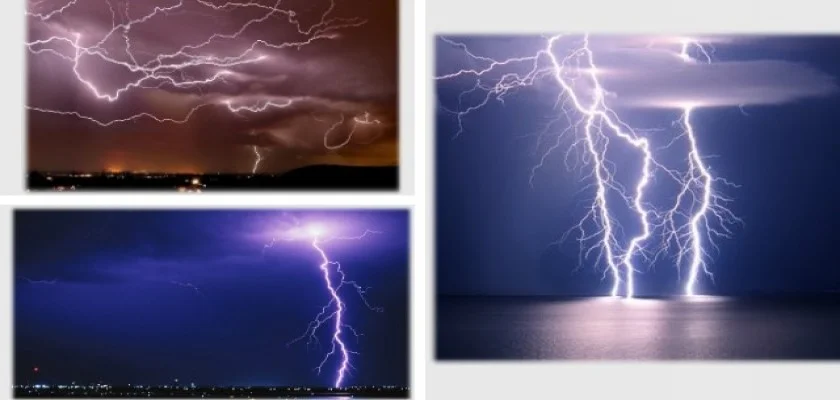
The Difference Between Lightning and Thunder
Although lightning and thunder are often referred to as the same natural phenomenon among the public, they are two different things. Lightning is an electric current that occurs between two clouds, while thunder is an electric current that occurs between a cloud and the earth. As high-voltage clouds form in the air, the lower part becomes negatively charged. The earth has a positive charge. As the conductive value between the cloud and the ground increases, a discharge occurs from the cloud to the ground or from the ground to the cloud. The current that occurs between two clouds is called 'lightning,' while the current that occurs between the ground and the cloud accompanied by thunder is called 'thunder.'
Lightning can strike the sky in nearly 40 consecutive zigzags. It is known that 50-100 lightning strikes occur in the world every second. While a very rapidly falling lightning strike descends from the cloud to the ground in 30 milliseconds, it returns from the ground to the cloud in 100 milliseconds. In lightning, which can strike the same place multiple times, the electric potential between the earth and the cloud reaches 100 million volts, and its heat reaches 30,000 degrees. People and buildings are damaged as a result of lightning strikes. Despite this, lightning has been observed to have a positive effect on plants. Plants grow faster thanks to lightning, which carries nitrogen compounds necessary for plant growth to the soil.